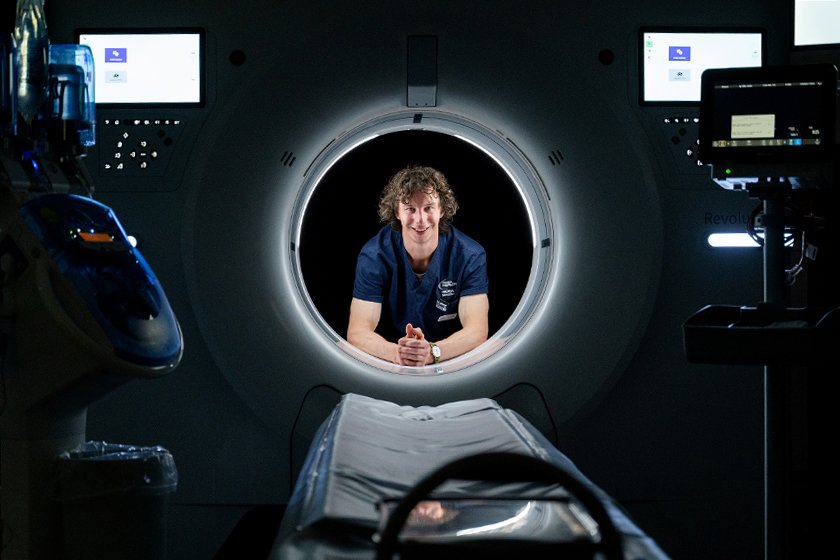
 Bendigo Health CT Supervisor, Howard Delahunty.
Bendigo Health's new CT scanner is bringing some of the most advanced medical imaging technology to regional Victoria, helping clinicians diagnose serious conditions faster and make critical treatment decisions with greater confidence.
From imaging the whole brain during stroke presentations to capturing detailed images of the heart and aorta, the recent technology is helping expand what's possible for patients across the Loddon Mallee.
Helping bring this capability to our region is CT Supervisor Howard Delahunty, whose own story is a powerful reminder of the importance of regional healthcare.
After receiving life-changing care as a baby, Howard has come full circle, dedicating his career to helping others access quality healthcare closer to home.
"It's better for patients, their families and the clinicians caring for them," Howard said.
Growing up on a farm near Horsham, Howard's future could easily have looked vastly different. Instead, the care he received from regional health services and specialists sparked a lifelong connection to healthcare. Today, that journey has come full circle.
"I probably wouldn't be here without the healthcare system," Howard said.
"After everything that happened, Mum was pretty keen for me to work in healthcare. I loved science, maths and physics, and radiography turned out to be where all those interests came together."
Howard's career has taken him from clinical radiography into highly specialised roles training clinicians and installing CT technology across Australia and New Zealand. But returning to regional Victoria and joining the public health system was always the goal.
Now, he is helping ensure people across the Loddon Mallee can access world-class imaging closer to home.
“This technology captures sharper images in less time by scanning large areas of the body to create a single image, helping clinicians identify life-threatening conditions faster and more accurately.”
It can image the whole brain during stroke presentations, reduce the amount of contrast needed for some scans, and reveal details that older technology may have missed.
For patients, which can mean fewer delays, fewer transfers, and faster treatment decisions.
"Some patients previously needed to be transferred to Melbourne because we couldn't definitively answer a clinical question," Howard said.
"Now we're able to provide much of that capability here. That's better for patients, their families and the clinicians caring for them.”
Find out more about medical imaging here.